Table of Contents
- Cyber Security Salaries in 2026: What Each Role Actually Pays
- Certifications That Actually Get You Hired vs. Ones That Just Look Good on Paper
- How to Get Hired in Cyber Security: A Step-by-Step Process
- Conclusion
- Frequently Asked Questions
The global cyber security workforce gap sits at 3.5 million unfilled positions in 2026, meaning qualified professionals are in high demand right now, not five years from now. Organizations across every sector, from fintech to healthcare to government, are actively hiring people who can defend systems, detect threats, and respond to incidents at speed. The opportunity is real, but generic career advice does not work in this field. You need to know which specific roles exist, what hiring managers actually look for, and which certifications move the needle versus which ones simply look good on paper. This guide covers every major cyber security job title, verified salary ranges by role and experience level, the exact skills and credentials required, and a step-by-step hiring path drawn from Cyberlad's hands-on experience delivering SOC consulting, threat intelligence, and penetration testing services across enterprise and SME environments.
Cyber Security Salaries in 2026: What Each Role Actually Pays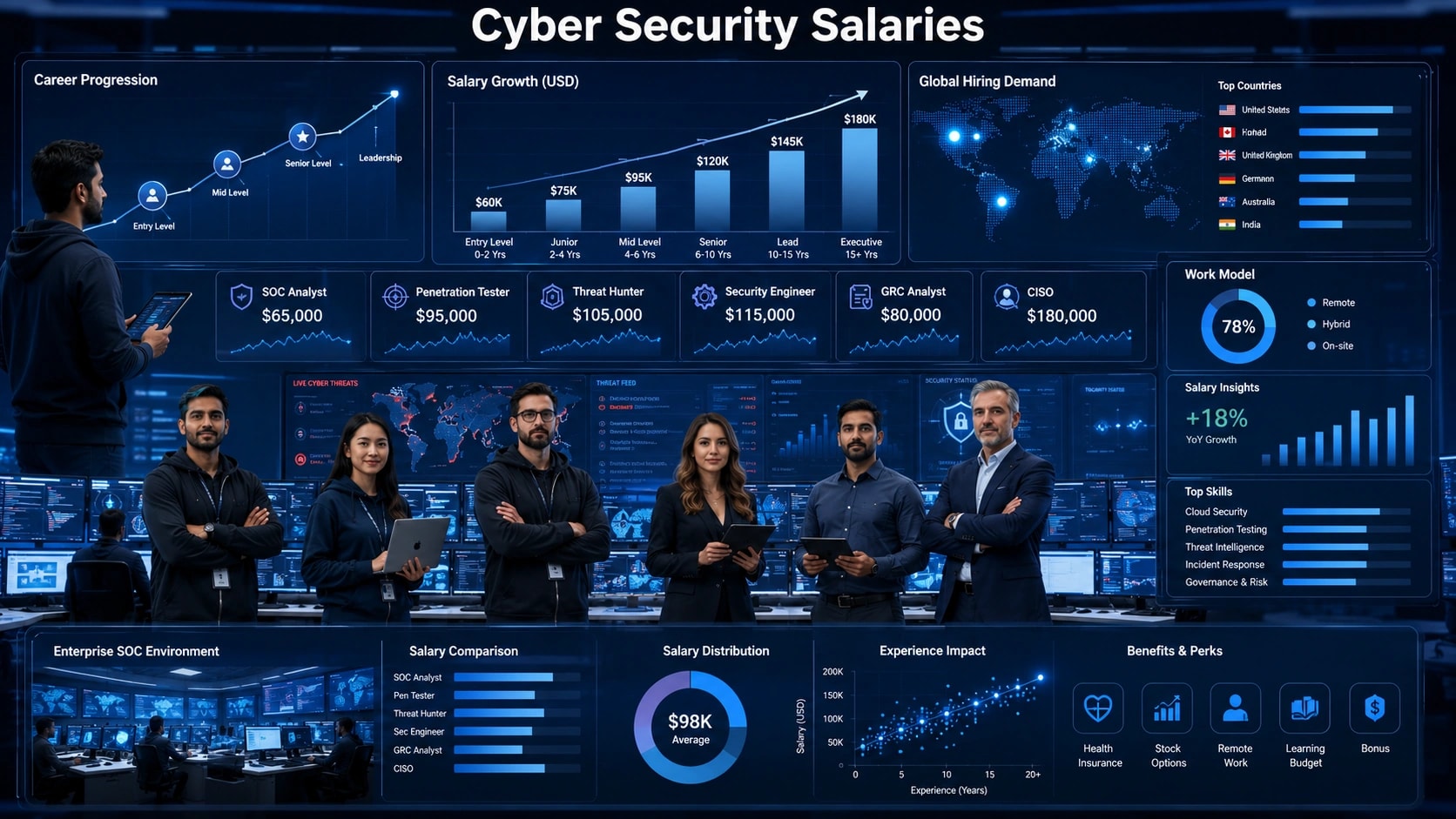
Salary in cyber security jobs varies significantly by role, experience tier, geographic location, industry vertical, and whether the position is in-house, consulting, or government. Many job listings obscure real compensation ranges, either because employers want negotiating leverage or because internal leveling has not been clearly defined. The table below provides verified salary bands drawn from Bureau of Labor Statistics data, industry compensation surveys, and Glassdoor aggregates, giving you a realistic benchmark before you enter any negotiation.
| Role | Entry Level (US) | Mid Level (US) | Senior Level (US) | UK Average (Mid) | Remote Premium |
|---|---|---|---|---|---|
| SOC Analyst | $50,000 to $65,000 | $70,000 to $90,000 | $95,000 to $115,000 | £38,000 to £52,000 | Up to 10% |
| Incident Responder | $70,000 to $85,000 | $90,000 to $115,000 | $120,000 to $140,000 | £48,000 to £65,000 | Up to 12% |
| Threat Hunter | $85,000 to $100,000 | $105,000 to $130,000 | $135,000 to $155,000 | £55,000 to £72,000 | Up to 15% |
| Penetration Tester | $75,000 to $90,000 | $95,000 to $130,000 | $135,000 to $165,000 | £50,000 to £75,000 | Up to 15% |
| Red Team Operator | $95,000 to $115,000 | $120,000 to $150,000 | $155,000 to $185,000 | £65,000 to £85,000 | Up to 18% |
| GRC Analyst | $60,000 to $78,000 | $85,000 to $110,000 | $115,000 to $145,000 | £42,000 to £60,000 | Up to 10% |
| Security Engineer | $80,000 to $100,000 | $110,000 to $140,000 | $145,000 to $175,000 | £55,000 to £75,000 | Up to 15% |
| CISO | N/A | $160,000 to $210,000 | $215,000 to $280,000+ | £100,000 to £160,000 | Varies by org |
Government and federally cleared positions at DoD or civilian agencies often pay lower base salaries than equivalent private sector roles. However, they offer significant non-cash benefits including job stability, defined pension contributions, structured training budgets, and in some cases relocation support. For candidates who prioritize long-term security over maximum cash compensation, cleared roles deserve serious consideration, particularly at the Tier 2 and Tier 3 SOC levels where the training pipeline is well developed.
Location continues to influence compensation even in remote-first hiring environments. Candidates based in New York, San Francisco, or Washington DC receive offers averaging 15 to 25 percent above national benchmarks, even for fully remote positions, because employers in high-cost markets calibrate offers to local talent competition. Cyberlad consulting engagements expose us to client hiring budgets across SME and enterprise organizations. The compensation gap that exists between what companies budget and what candidates expect is frequently a result of poorly defined role scoping rather than genuine market mismatch, and understanding that distinction strengthens your negotiating position.
Certifications That Actually Get You Hired vs. Ones That Just Look Good on Paper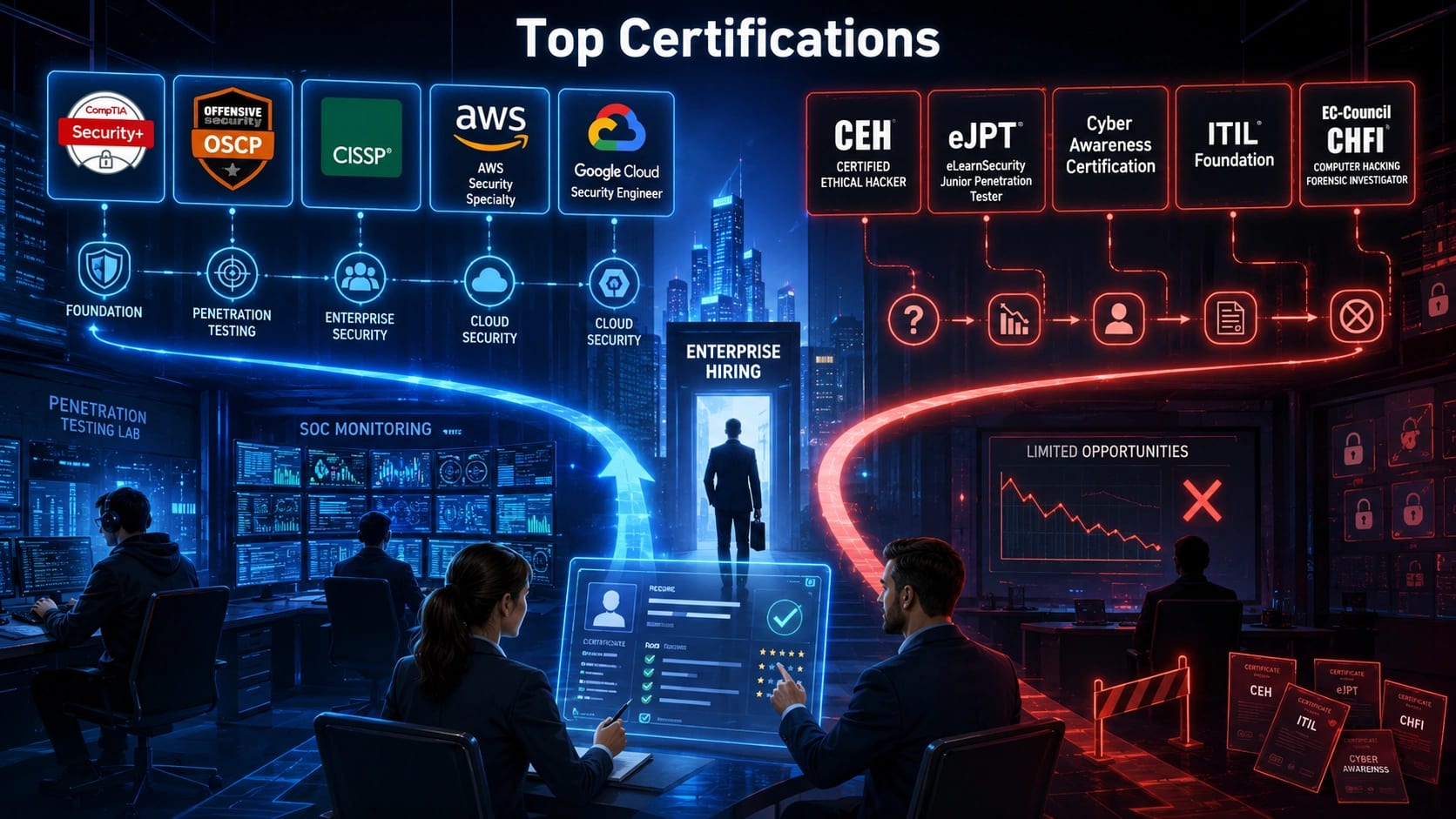
Entry-Level Certifications vs. Advanced Technical Credentials
How to Get Hired in Cyber Security: A Step-by-Step Process
Building a Portfolio That Technical Hiring Managers Actually Respect
𝗛𝗼𝘄 𝘁𝗼 𝗚𝗲𝘁 𝗛𝗶𝗿𝗲𝗱 𝗶𝗻 𝗖𝘆𝗯𝗲𝗿 𝗦𝗲𝗰𝘂𝗿𝗶𝘁𝘆: 𝗔 𝗦𝘁𝗲𝗽-𝗯𝘆-𝗦𝘁𝗲𝗽 𝗣𝗿𝗼𝗰𝗲𝘀𝘀
Getting hired in cyber security jobs follows a different process than most IT roles. Hiring managers at security teams are skeptical of credentials without demonstrated practical ability, and they are experienced enough to identify candidates who have studied concepts without having applied them. Your application needs to show evidence of hands-on work, not just a list of tools you have read about.
The hiring path also differs depending on your starting point. Candidates transitioning from IT roles such as systems administration or network engineering have relevant technical foundations and should focus on mapping existing skills to security contexts. Career changers from non-technical backgrounds need to invest more heavily in foundational lab work and structured learning before applying. Candidates already working in security-adjacent roles need to demonstrate depth in their target specialization.
The five-step hiring path that produces results is: identify your target role based on skills, interest, and verifiable market demand; map your skill gaps and build a 90-day study and lab plan with specific milestones; build a portfolio of documented technical projects that hiring managers can review before an interview; optimize your resume for technical screening with specific tool names, frameworks, and measurable outcomes; and prepare for technical screening assessments with structured practice rather than passive review.
Platforms including TryHackMe, Hack The Box, and SANS Cyber Aces provide structured labs that produce shareable evidence of practical skill. Completed rooms, rankings, and writeup documentation belong on your resume and LinkedIn profile, not just in your notes. The Cyberlad team has reviewed and mentored candidates entering cyber security jobs across multiple disciplines, and the most consistent reason strong candidates fail to receive callbacks is a resume that lists tools and concepts without demonstrating what those candidates actually did with them. Context and outcome matter more than tool name recognition.
Building a Portfolio That Technical Hiring Managers Actually Respect
A cyber security portfolio is not a PDF of certifications or a list of courses completed. It is documented evidence of technical work that a hiring manager can verify and evaluate before you walk into an interview. The format varies by role, but the principle is consistent: show the work, show the methodology, and show that you can communicate technical findings clearly.
For offensive security candidates, publish Hack The Box or TryHackMe writeups on a personal blog or a well-maintained GitHub repository. Document your methodology in detail, not just the commands you ran or the flags you captured. Explain the thought process behind your privilege escalation path, why you chose a particular lateral movement technique, and what you would report to a client if this were a paid engagement. Hiring managers reading this content are evaluating your reasoning as much as your technical execution.
For defensive candidates, document a home lab SIEM deployment from initial setup through ingesting log sources and writing custom detection rules. A concrete example carries significant weight: documenting how you detected Mimikatz execution via Windows Event ID 4688 with a custom Sigma rule, tested against a deliberately vulnerable environment, demonstrates more capability than any number of completed courses. Write it up clearly, publish it publicly, and link it from your resume and LinkedIn profile.
Bug bounty reports submitted through HackerOne or Bugcrowd, even low-severity findings, demonstrate real-world application security testing and familiarity with responsible disclosure processes. A documented history of submitted reports signals sustained engagement with the security community, not a burst of activity during a job search.
A common mistake is submitting a GitHub profile with empty or abandoned repositories, or a blog with two posts written 18 months ago. Recency and consistency signal active skill development. Hiring managers reviewing portfolios as part of screening notice the timestamps, and a stale portfolio suggests the candidate stopped learning when the job search paused.
Resume, LinkedIn, and Interview Tips for Cyber Security Jobs
Cyber security resumes should open with a technical summary section that names specific skills in concrete terms. List the SIEM platforms you have worked with, the scripting languages you use, the frameworks you apply (MITRE ATT&CK, NIST CSF, OWASP), and the tools you operate daily (Burp Suite, Nessus, Velociraptor, CrowdStrike). Soft skills and adjectives like "detail-oriented" and "proactive" waste space that should be occupied by technical specifics. Technical hiring managers skim resumes for evidence of tool and framework familiarity before reading anything else.
Quantify impact wherever your experience allows it. "Reduced mean time to detect from four hours to 45 minutes by building custom correlation rules in Splunk" is a hiring manager's attention. "Improved detection capabilities" is noise. Even in lab or volunteer contexts, you can quantify: number of vulnerabilities identified, detection rules written, incidents triaged, or findings reported.
LinkedIn optimization follows the same logic. Recruiters and hiring managers search by specific tool names and certification labels. Include OSCP, Splunk, CrowdStrike, Azure Sentinel, and your target role title in your LinkedIn headline and About section. This is not keyword stuffing, it is matching the search terms that decision-makers actually use when sourcing candidates proactively.
Technical interviews for hands-on roles increasingly include live challenge components: a packet capture to analyze, a phishing email to triage, a CTF-style scenario to work through, or a code review task. Specialized assessment platforms are used by enterprise employers to screen at scale before any human interview takes place. Practice explaining your thought process out loud while working through these challenges. Hiring managers at technically rigorous organizations are evaluating your structured problem-solving approach as much as whether you reach the correct answer.
A critical interview mistake is focusing exclusively on what you already know instead of demonstrating methodical reasoning when you encounter something unfamiliar. Saying "I have not worked with that specific tool, but my approach to investigating this type of event would be to start with X, correlate against Y, and verify by checking Z" demonstrates the analytical framework that transfers across tools. Memorized answers to expected questions are far less impressive to experienced security practitioners than the ability to reason clearly under uncertainty.
Networking inside the security community significantly accelerates the hiring process. BSides events, local OWASP chapter meetings, and active participation in Discord communities such as TryHackMe's server put you in direct contact with practitioners who refer candidates internally, post about openings before they hit job boards, and can speak to your skills based on real interaction rather than a cold resume submission.
Conclusion
Cyber security jobs offer one of the most in-demand, well-compensated, and technically stimulating career tracks available in the technology sector, but only for candidates who approach it with role-specific preparation rather than generic IT career advice. The path is concrete and repeatable: identify your target role with precision, map the skills and certifications that employers in your target market actually require, build documented hands-on evidence of your ability, and present that evidence clearly in your resume, portfolio, and LinkedIn profile. Candidates who follow this process consistently outperform those who rely on certifications alone or apply broadly without a focused strategy.
Cyberlad works across SOC consulting, penetration testing, threat intelligence, and cloud security, and the structured, evidence-based approach applied to client security programs is the same thinking that gets candidates noticed in competitive hiring pipelines. Whether you are targeting your first SOC analyst position or moving toward a senior red team operator role, the principles in this guide give you a concrete starting point with specific actions you can take this week, not vague advice to simply "get more experience." Visit cyberlad.io to explore Cyberlad's services and resources, and follow us for ongoing career and technical content built for serious cyber security professionals who want real-world insight, not recycled career tips.
Frequently Asked Questions
Do I need a degree to get a cyber security job?
No. Many employers prioritize certifications, hands-on skills, and portfolio evidence over a degree. CompTIA Security+, OSCP, and demonstrable home lab experience regularly get candidates hired without a four-year degree. Some government and enterprise roles still list degrees as preferred, but exceptions are common for strong candidates.
What is the best entry-level cyber security certification?
CompTIA Security+ is the most widely recognized entry-level certification and is often listed as a baseline requirement. For hands-on defensive roles, Blue Team Labs One (BTL1) is highly practical. Choose based on your target role: Security+ for broad appeal, BTL1 for SOC analyst positions.
How long does it take to get a cyber security job with no experience?
Typically 6 to 18 months of focused effort. Build certifications, a home lab, and a GitHub portfolio simultaneously. Candidates who skip hands-on evidence and rely on certifications alone take longer. Consistent effort across all three areas is the fastest route to a first role.
Is cyber security a good career in 2026?
Yes. The global workforce gap is 3.5 million unfilled roles. Salaries are strong, remote work is common, and demand is growing across every sector. It remains one of the most stable and well-compensated technical career paths available.
What cyber security jobs pay the most?
CISOs, Security Architects, and senior Red Team Operators command the highest salaries, ranging from $130,000 to over $280,000 in the US. Cloud security and threat intelligence roles also pay well above market. Specialization and demonstrated impact drive compensation more than years of service.
Can I move into cyber security from a different IT role?
Yes, and it is a common path. Networking, sysadmin, and development backgrounds each translate well into specific security disciplines. Network engineers often move into security architecture; developers into application security. Map your existing skills to the closest security role and upskill from there.
What do cyber security hiring managers actually look for?
Demonstrated practical skills, not just certifications. A GitHub portfolio, documented home lab projects, and the ability to explain your methodology in technical interviews matters most. Communication skills are also critical, since most roles require reporting findings to non-technical stakeholders.
For SOC and detection-focused roles, hiring managers most frequently cite CompTIA Security+ as the recognized baseline, followed by vendor-specific SIEM certifications such as Splunk Core Certified User or Microsoft SC-200. The Blue Team Labs Level 1 (BTL1) credential is gaining strong recognition for entry-level SOC candidates because it requires completing practical, scenario-based challenges rather than passing a multiple-choice exam. For penetration testing roles, the OSCP from Offensive Security is the single most respected credential at technical organizations because of its 24-hour practical examination format. At the advanced level, CRTO is valued for red team operator positions and eWPTX for web application penetration testing specialization. Cloud security roles across both disciplines increasingly require AWS Security Specialty, Microsoft SC-100, or equivalent platform-specific credentials as a baseline, not an optional addition.